

How to Complete a Seafarers Tax Return
- Authors
-
-

- Name
- Patrick Maflin
-
To complete a seafarers tax return, you must register for HMRC Self Assessment, declare your worldwide income, and claim the Seafarers Earnings Deduction (SED), assuming you meet the qualifying conditions.
Put simply, qualifying seafarers can potentially reduce their UK income tax liability to zero on eligible overseas earnings by correctly filing their tax return and maintaining accurate travel and employment records.
For many yacht crew and commercial seafarers, the process may sound complicated.
But once you understand the rules around qualifying periods, time spent outside the UK, and the records HMRC expects you to keep, completing a seafarers tax return becomes far easier.
Key Takeaways
- Most seafarers claiming the Seafarers Earnings Deduction must complete an HMRC Self Assessment tax return
- You must keep detailed travel, employment, and sea service records
- SED usually requires a qualifying period of at least 365 days
- Time spent outside the UK is critical to eligibility
- You must still declare income to HMRC even if your earnings qualify for tax relief
- Filing mistakes or poor record keeping can delay or invalidate a claim
- Speaking to a seafarers tax specialist can help avoid costly errors
Chapters
- What is a Seafarer's Tax Return?
- Steps to Completing a Seafarers Tax Return
- Frequently Asked Questions
- Final Thoughts
What is a Seafarer's Tax Return?
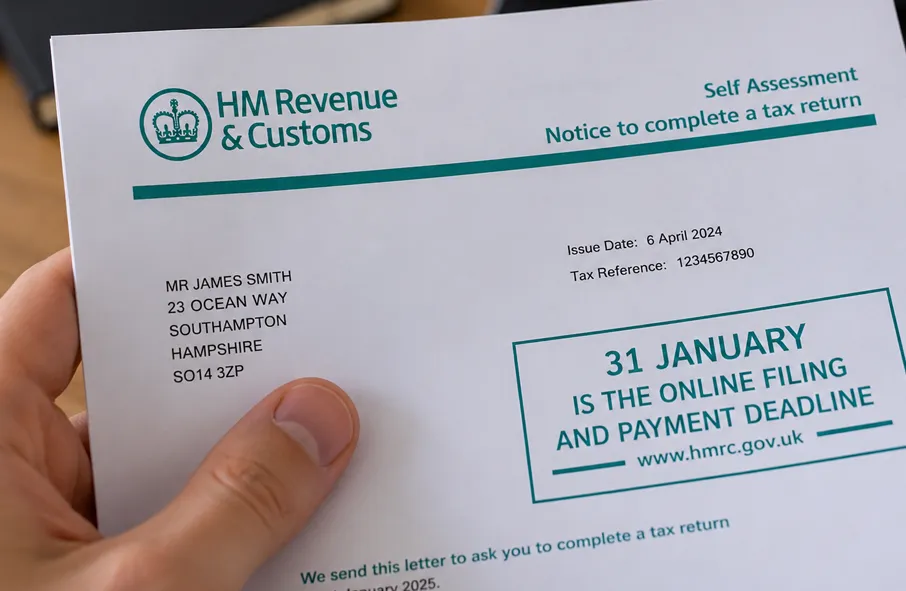 A seafarer’s tax return is a standard HMRC Self Assessment tax return completed by someone working at sea, usually to declare income and claim the Seafarers Earnings Deduction.
The Seafarers Earnings Deduction is a form of UK income tax relief available to qualifying seafarers who spend sufficient time working outside the UK on a ship.
Assuming all conditions are met, the deduction can reduce the UK income tax due on eligible earnings to zero.
Importantly, the deduction does not automatically apply.
Even if you qualify, you must still complete and submit a Self Assessment tax return correctly in order to claim it.
This is where many new yacht crew come unstuck.
They incorrectly assume that because they’re paid offshore or spent most of their time abroad, they do not need to file anything with HMRC.
In reality however, many seafarers remain UK tax resident and must continue reporting their income properly each tax year.
Steps to Completing a Seafarers Tax Return
1. Register for Self-Assessment
Before you can file a seafarers tax return, you must first register for Self Assessment with HMRC.
If you’ve never completed a tax return before, HMRC will issue you with a Unique Taxpayer Reference number, often called a UTR number.
This is used to identify your tax records and access HMRC’s online filing system.
Registration should be completed as early as possible because obtaining login credentials and activation codes can take time, especially if you’re working overseas.
Once registered, you’ll complete the standard SA100 Self Assessment tax return along with any relevant supplementary sections required for your circumstances.
When claiming Seafarers Earnings Deduction, many seafarers also use HMRC Helpsheet HS205 to calculate and support their claim.
2. Keep all Necessary Records
Record keeping is one of the most important aspects of successfully claiming the Seafarers Earnings Deduction.
HMRC may ask you to prove your qualifying period, travel history, employment details, and vessel information.
If your records are incomplete or inconsistent, your claim may be delayed or rejected.
You should keep copies of:
- Employment contracts
- Crew agreements
- Discharge books
- Passport stamps
- Flight tickets and boarding passes
- Marina or hotel receipts
- Vessel itineraries
- Payslips and bank statements
- Details of all ships worked on
- Dates joining and leaving vessels
Many experienced seafarers also maintain a spreadsheet or logbook recording all movements in and out of the UK.
This can become extremely valuable when calculating eligible periods later on.
Good records not only protect your claim, but also make completing future tax returns significantly easier.
3. Check You Are Eligible
This is the stage where many seafarers misunderstand the rules.
Simply working on a yacht or commercial vessel does not automatically qualify you for the Seafarers Earnings Deduction.
HMRC has specific conditions that must be met.
Firstly, you must generally work on a ship.
Certain offshore installations and fixed platforms may not qualify.
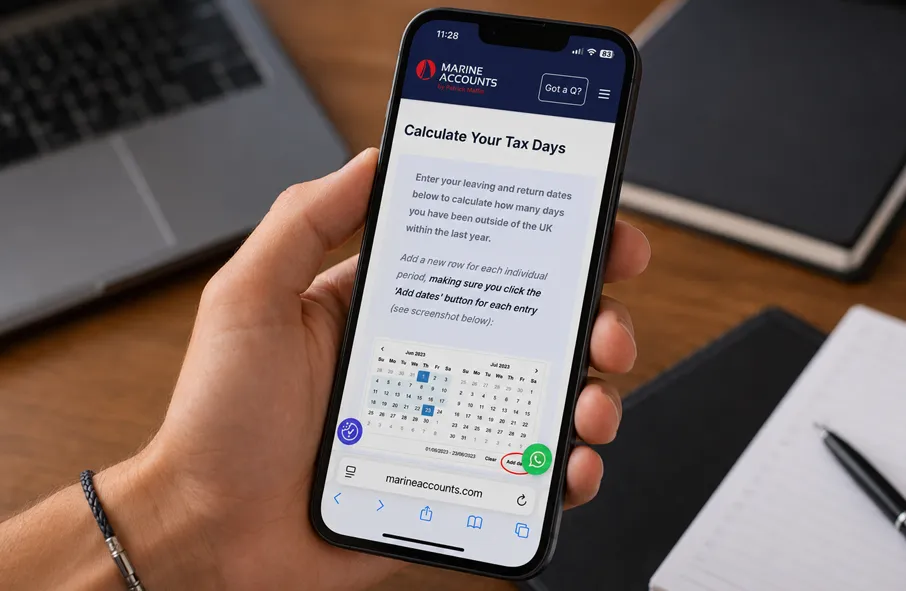
Secondly, you must complete an “eligible period”, which usually means calculating your tax days by spending at least 183 days outside the UK in any given 365 day period.
Thirdly, your work must involve sufficient time outside the UK.
For HMRC purposes, outside the UK generally refers to being beyond UK territorial waters at midnight.
Time spent within UK waters does not usually count toward qualifying days.
This is why accurate travel records are so important.
The eligible period rules are often where yacht crew trip up.
A contract may last over a year, but excessive time spent back in the UK between rotations could break the qualifying period.
Understanding this calculation properly is critical before filing a claim.
4. File Before 31st of January
The online filing deadline for UK Self Assessment tax returns is midnight on 31 January following the end of the relevant tax year.
For example, the 2025/26 tax year ends on 5 April 2026, and the filing deadline would usually be 31 January, 2027.
Missing the deadline can trigger automatic penalties and interest charges, even if no tax is ultimately due because of the Seafarers Earnings Deduction.
This is another common misunderstanding among yacht crew.
Some believe that if they owe no tax, deadlines do not matter.
Unfortunately, HMRC still expects the return to be submitted on time.
Filing early is usually the best approach because it allows time to correct mistakes or provide additional evidence if HMRC raises questions.
5. Speak to a Seafarers' Tax Specialist
While some seafarers successfully complete their own returns, many choose to work with accountants who specialise in maritime taxation.
This is particularly useful for yacht crew with complex travel patterns, multiple employers, foreign currency income, or uncertainty around qualifying periods.
A specialist understands how HMRC interprets the rules and can help ensure your return is accurate, compliant, and completed correctly.
For many seafarers, professional advice ultimately saves far more money and stress than it costs.
Frequently Asked Questions
Who is Considered a Seafarer?
For tax purposes, a seafarer is generally someone who works aboard a qualifying ship as part of the crew.
This includes many commercial shipping crew, offshore workers, and yacht crew.
However, simply working near water or on offshore structures does not necessarily mean you qualify.
Eligibility depends on the nature of the vessel and the duties performed onboard.
What’s Considered ‘Outside the UK’?
For Seafarers Earnings Deduction purposes, time outside the UK usually means being beyond UK territorial waters at midnight.
This distinction is important because many yacht crew incorrectly assume that simply leaving a UK marina automatically counts as a qualifying day.
The calculation is more technical than that, which is why accurate itineraries and travel records are essential.
What Does ‘Eligible Period’ Mean?
The eligible period is the qualifying timeframe used by HMRC to determine whether you meet the requirements for Seafarers Earnings Deduction.
In most cases, this period must last at least 365 days and contain sufficient qualifying travel outside the UK.
Breaking the eligible period incorrectly can invalidate a claim.
Do Seafarers Pay National Insurance?
National Insurance payments in the UK are directly linked to eligibility for certain state benefits, most notably the UK State Pension.
If you are claiming the SED and therefore have no UK tax liability, you are generally not required to pay NI through your tax return.
However, this also means you are not automatically building up NI qualifying years, which could impact your future entitlement to the State Pension and other contribution-based benefits.
In some cases, NI contributions are not optional.
If you work on a UK or Isle of Man flagged vessel, or for a UK or Isle of Man based employer, you are generally liable for mandatory Class 1 NICs.
This will be deducted automatically through payroll.
However, yacht crew and seafarers working internationally often do not have NI deducted, which can result in gaps in their NI record.
To avoid this, many seafarers choose to make voluntary NI contributions to maintain or build their entitlement.
To read more about NI and making voluntary contributions please refer to our article.
How Many Holiday Days Can I Claim?
Certain leave periods connected to qualifying employment may count toward the eligible period, but the rules are detailed and greatly depend on how the leave relates to your seafaring duties.
This is another area where a specialist tax advisor can be invaluable.
Will a Second Job Affect My Claim?
A second UK-based job does not automatically prevent you from claiming the Seafarers Earnings Deduction on qualifying seafarer income.
However, income from non-qualifying work may still remain taxable in the UK.
This can make the overall tax calculation more complicated, especially where multiple employers or PAYE income are involved.
Final Thoughts
Completing a seafarers tax return is about far more than simply submitting a form to HMRC.
It involves understanding residency rules, maintaining detailed records, calculating eligible periods correctly, and ensuring your claim for Seafarers Earnings Deduction is fully supported.
For yacht crew and commercial seafarers, the potential tax savings can be significant.
But those savings depend on getting the details right.
Yacht crew who experience the smoothest tax return process are usually those who stay organised throughout the year, keep accurate travel records, and get professional advice from a tax specialist when needed.
While the rules may initially appear complicated, the process becomes much clearer once you understand how HMRC approaches qualifying periods and overseas work.
With the right preparation, completing a seafarers tax return can become a straightforward annual process rather than a stressful one.
Disclaimer: Any advice in this publication is not intended or written by Marine Accounts to be used by a client or entity for the purpose of (i) avoiding penalties that may be imposed on any taxpayer or (ii) promoting, marketing or recommending to another party matters herein.